Large language models have demonstrated strong potential in long-horizon decision-making tasks, such as embodied manipulation and web interaction. However, agents frequently struggle with endless trial-and-error loops or deviate from the main objective in complex environments.
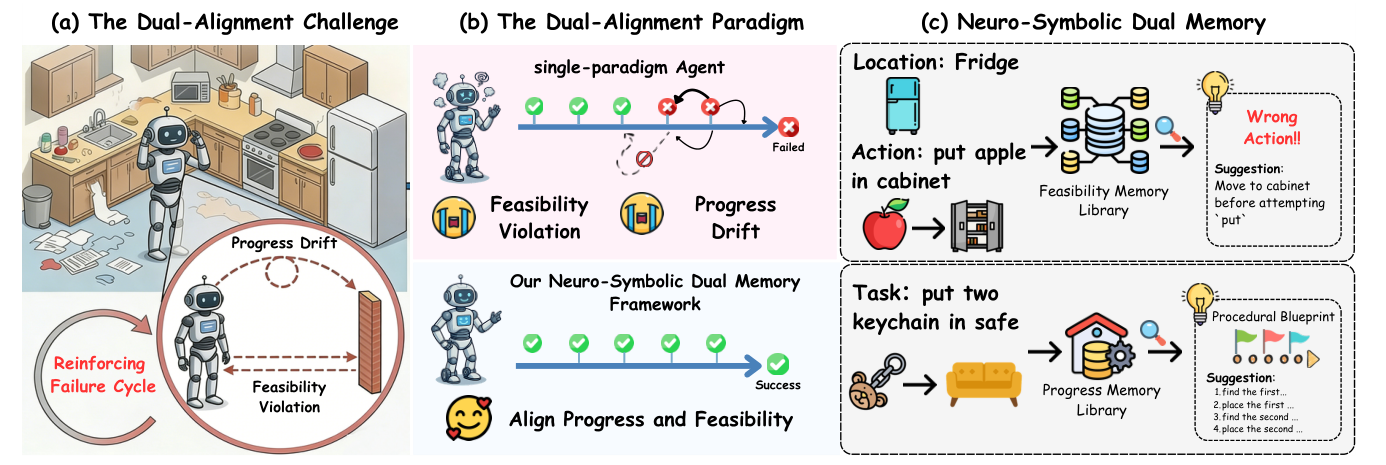
We attribute these failures to two fundamental errors: global Progress Drift and local Feasibility Violation. Existing methods typically attempt to address both issues using a single paradigm, although progress guidance relies on fuzzy semantic planning while feasibility verification requires strict logical constraints and state validation.
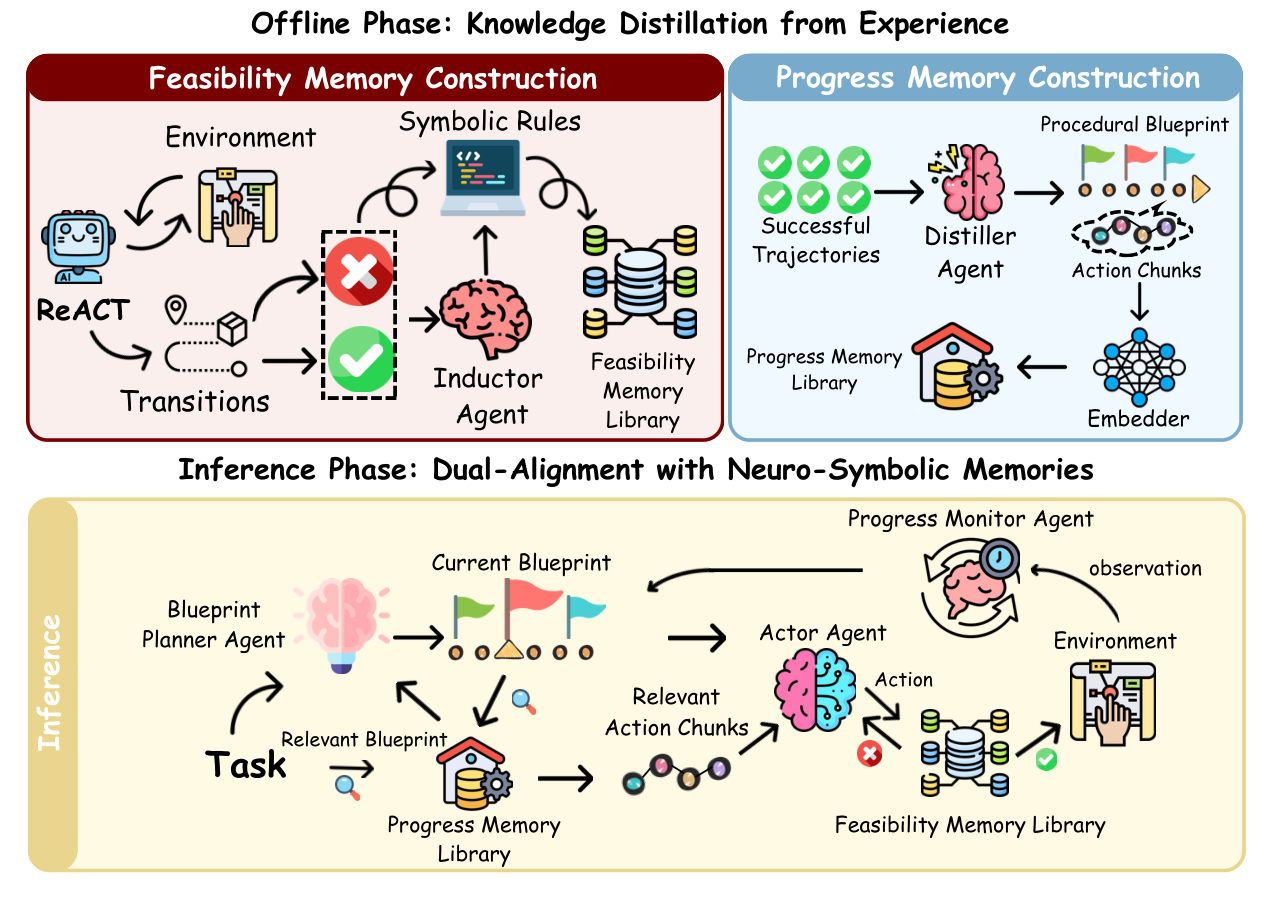
We propose a Neuro-Symbolic Dual Memory Framework that explicitly decouples these objectives. A neural Progress Memory extracts semantic blueprints from successful trajectories to guide global task advancement, while a symbolic Feasibility Memory synthesizes executable Python verification functions from failed transitions for strict local validation.